Saturday, April 27, 2013

No Pain, No Gain


Last week I was honored to share and hear great leaders at Exponential in Orlando. I went with our network, Planting the Gospel, led by David Putman. In addition to connecting with leaders and planters, we also connected with some pretty good restaurants. One night, near the point of starvation, we pulled into Landry's, a seafood spot in Orlando, and we sinned terribly. After consuming gumbo, shrimp, salad, and fish, our entire team was in need of repentance. 

When we returned to the house, David and I decided we were going to punish ourselves for our gluttony with a four mile run...with full stomachs. My normal range is two miles, but due to my sinful state of over indulgence, four miles sounded like ample punishment. 

After two miles, my side began to cramp (and all I could taste was shrimp); I slowed my pace and David began to pull ahead. He glanced back and asked, "Are you o.k.?" I replied, "I have a cramp in my side." What I was hoping to hear was, "Let's slow it down" or "Let's rest for a minute." Instead, without missing a beat David said, "Suck it up, let's go" After a few minutes (and a large burp) the pain left and we continued the run. David eventually pulled ahead, and when I finished the fourth mile, David was waiting for me at the gate of the neighborhood we were staying in. He jogged the last stretch with me. 

As I was finishing my last mile, God spoke this to me. 

1) Leaders need Conditioning: I had to slow my pace at mile two because I did not condition myself beyond the two mile mark. As leaders, it is up to us to push ourselves, grow ourselves, and condition ourselves for the race that God has set before us. We must set the pace for our team. If we're not living a disciplined life, we shouldn't expect our teams to. 

2) Leaders Don't Give in: David could have easily said, "Let's rest," but instead said, "Suck it up." When your team is assigned to do something that is out of their comfort zone, often they will respond painfully, hoping you'll say, "Let's rest." When the leader slows down, the pace slows down, and then everything slows down. Rest is important, but we should never slow down simply because a team member is lazy and has refused to condition himself. The only reason I finished the four mile haul without stopping is because I was challenged. 

3) Leaders Finish Well: Although David finished before me, he was there when I arrived. Good leaders should be ahead of their team; if they're not,  they aren't leading. Good leaders also go back and help their team to finish well. On our last stretch David encouraged me and bragged on me for not quitting...as a result, my milage range has changed. 

Final thought...

Set the pace, challenge your team, and help them finish well. 


Monday, April 22, 2013

Exponential 2013

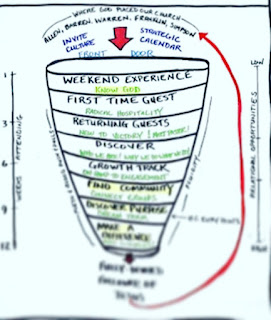
 I'll be doing a break session on disciple-making assimilation.  Assimilation is often about moving people into membership or partnership. What would an assimilation process look like that moved people towards becoming a Christ-centered disciple? This workshop turns our traditional approach to assimilation on its head, creating a model where our weekend services becomes a step towards making disciples and leaders. 
Time: Thursday 8:45-9:45am
Location: Educational Building E-2 332

Meet me there! 

Friday, March 22, 2013

Staying Alive in a Growing Church


   There's lots of things in the world that creates energy and excitement; a championship basketball game, the Super Bowl, or even a good movie. Yet I believe there's hardly anything that can compete with the excitement of a growing church, especially if you're a pastor or serve on staff at a church. Every pastor wants his church to grow; and when it does, it is exhilarating. However, with success comes stress and when a lead pastor and staff ignores the stress, the season of success can be short lived. Typically growth-related stress hurts us because it causes us to neglect crucial areas in our own personal lives. 

    Here are three train-wrecks you want to avoid as your church grows. As a lead pastor, you need to make sure your staff is aware of these as well.  If you'll take care of these, chances are, you and your staff will stay alive and endure the stress that comes with the success of every growing church. 


  • Grocery-Store Death: Too often pastors and lead staff spend all their energy and efforts in seeing that others are spiritually well fed, while they starve to death. They will read, plan, and prepare lessons and sermons to share with their people. Of course, God speaks to us in our planning and prepping, but we must break the habit of searching for a sermon every time we open the Bible. We need to read God's Word for ourselves. When your Bible time is always a sermon search, you'll go hungry. It's the same as starving to death in a grocery store; you feed everyone but yourself. Read Hebrews 4:12. Remember, you need the Word of God for YOU. You need it's life-giving power in your personal life. Don't feed the people, while starving to death yourself. Feed yourself too, and then you'll be able to better feed others. 
  • Prayer-Warrior Sickness: As leaders, we spend a lot of our time praying for the needs of others. It's good to pray for others, but don't neglect your own prayer life. When praying for others becomes the definition of your prayer-life, you quickly become the devil's punching bag. Read Matthew 16:18-19. Jesus gave YOU power to overcome the adversities in your own life. Pray for others, but make time to sit at the feet of Jesus and let him minister to your needs too; then you can better pray for others. 
  • Cheerleader Crisis: Every weekend we encourage people to worship God. We pour tons of energy into making sure the worship songs, the instrumentation, and the sermons are powerful. Yet don't allow what you do on Sunday to define your worship. When intimate worship is missing in our personal lives, we unintentionally become a weekend cheerleader. The truth is, while we do worship God on the weekends, as pastors and leaders, we are still always working. You need your worship with God. Read John 4:23-24. Jesus said God is looking for true worshippers (which means there is a false worship). Our worship must be deeper than a weekend service. Put on some groovy worship tunes, shut the door, bow before Him, and worship Him! It'll change your life! 


Monday, February 18, 2013

Should church be comfortable?

  When my youngest daughter was little, she used to watch a kid's show called "The Big Comfy Couch." It always started with a woman, who was dressed like a little girl, sitting on a huge couch. I always wondered why a couch had to big in order to be comfy. My daughter loved it; I hated it, but like most dads, endured it. 

  I was reminded of that show today during lunch, when I ran into a Cavelander at the local Pizza Hut. This guy has been with us a long time. I have always had the utmost respect for him and his wife because they stuck with us when we went from a traditional to post-modern model, despite the fact they're from the older generation. During lunch he gave me one of the best compliments I have ever received about our church. He said, "You know Chad, Caveland Church isn't comfortable. It's not a church where you can come in and sit down and get comfy." I'm not sure he knew it was a compliment, but it was. 

  Over the years I have learned that comfort and challenge cannot exist in the same room. I have also learned that challenge pulls out the potential of our people. Our weekend services should be a place of worship, fellowship, and yes, they should also be a place where people are challenged to follow and obey Jesus. Some may argue that following Jesus isn't uncomfortable. Yet I remember the response Jesus gave to those who said, "Hey Jesus, we'll follow you!" Jesus said, "The birds have nest, the foxes have dens to sleep in, but the Son of Man has no where to rest his head." In other words, following Jesus isn't comfortable, matter of fact, it's kinda messy. 

  My prayer is that I'll never run into a Cavelander who says, "Man, Caveland is so comfortable!" Because where there is no challenge, there is no mission. 


Thursday, February 14, 2013

Lead Pastor Gathering

Planting the Gospel
Lead Pastor Gathering

This is a gathering of Lead Pastors who want to participate in peer learning and develop growth and discipleship strategies. Each group will be limited to twelve lead pastors and two team members. Groups will meet twice per year, on six month intervals. Our goal is to build groups of passionate, innovative leaders, who will sharpen each other to become better leaders and pastors. We are not looking for the fastest growing churches in America; instead we are looking for pastors and churches of all sizes, who have the potential and desire to become a growing church by making disciples and making a gospel impact.

What will it look like?

Let me begin by telling you what it will not look like. This will not be a sit in your chair, take notes, while listening to speakers tell you about the latest and greatest church growth tricks. So if you’re a conference junkie, this probably isn’t for you. There's no conference smoke here...just nuts and bolts stuff in a high level learning environment.

Our gatherings will consist of FIVE pieces:

1) Organic Conversations: This is totally an “iron sharpening iron” environment that happens in different formats. These conversations are guided by a mentor, but require participation from every pastor. The higher the participation, the greater the learning experience. They are called organic because typically we’ll bleed in other topics that are relevant.

2) Mentoring Sessions: Each gathering will include a session where our mentors will unpack a relevant, valuable topic pertaining to church growth and disciple-making strategies. These sessions will be determined by topics and trending issues that arise from within the group. In other words...it'll be stuff you can use. 


3) Strategy Sessions: Each pastor will be provided with a strategic planning poster, which will help his team create a current snapshot of their church; pinpoint what’s working, what’s stuck, road blocks, objectives, etc. At the end of our first meeting, each pastor will leave with a six month strategy built through the wisdom and collaboration of mentors and eleven other like-minded pastors.

4) Relationships: Planting the Gospel is intentional in creating family. During our gatherings, you will make relationships with those in your group; most become life long relationships. 

5) Monthly PTG Coaching: In addition to our LPG gatherings, each lead pastor will receive monthly coaching and leadership webinars, as well as access to resources in our PTG Vault. Lead pastors will also have reasonable access to mentors during the two year term. 


What's it Cost?

This two year relationship gives you and your team the following:  


  • Four gatherings (eight days) with like-minded pastors
  • 2 years of monthly virtual coaching & access to Planting the Gospel leadership Vault
  • Reasonable access to Planting the Gospel mentors during the two year term. 

Total Cost:  

Lead Pastor Two-Year Relationship: $2400.00 or $100.00 per month
Additional Team members: $50.00 per team member per gathering

Group 1 May 20-21, Caveland Church, 9315 Happy Valley Rd. Cave City, KY 42127 (Group One is full)

Group 2 July 15-16, Revolution Church, 311 Jesse Jewell PKWY SW, Gainesville, GA, 30503


Group 2 Registration


Planting the Gospel Lead Pastor Mentors

David Putman


David is a Speaker, Leader, Coach, and Founder of Planting the Gospel, a network of gospel-centered churches committed to taking the whole gospel to the whole world. David has coached hundreds of pastors of leading churches and has authored several books, including Breaking the Discipleship CodeDetox for the Overly Religious, and co-authored Breaking the Missional Code with Ed Stetzer. 

Chad Hunt
Chad is a Practitioner, Leader, Coach and Lead Pastor of Caveland Church in Cave City, Ky. Caveland Church reaches 700 people in a community of 2,000 people and operates three recovery homes. He is the author of Seven Things that can Cripple Your Church, that will be released in 2013 and the founder and author of Addiction Deliverance Outreach book and workbook, a recovery model that is now used nationwide. 


Thursday, January 3, 2013

Prevent a Church Heart-Attack!


         There's a lot of Sundays that I'll never forget; but there's one in particular that will always stand out. My wife and I just left the church and were on our way to grab lunch. Before we left the parking lot, my phone rang; it was my mom. She informed me that my dad was having a heart-attack. 

       When we arrived at the hospital, the doctor said my dad's main artery was blocked; the outlook was grim. Immediately I called on my church family, pastors friends, and twitter friends for prayer. The end result was a miracle; the doctor said the blockage (that would not move) miraculously broke loose. He put a stint in and today my dad is going strong. I am grateful. 

       The Bible calls the church a body (1 Cor. 12) with Jesus as the head. The ministry of the church is her heart; and the enemy is constantly trying to slow down the flow that feeds it. He knows when a heart isn't receiving a healthy flow, it affects the overall body. When the flow of ministry becomes blocked with distractions, frustrations or conflict, the productivity of the heart lessens; ministry becomes weak...and sometimes dies. 

       If ministry is the heart of our churches, then your lead team is the arteries; they are the ones who pour into the heart of ministry more than anyone else. Effective churches are effective because their heart (or ministry) is receiving a good flow of the essentials, which creates a healthy, functioning body of believers. 

     As a pastor, you must encourage, coach, and monitor the disciplines of your lead team; make sure the right essentials are flowing in their personal lives. Prayer, Bible reading, family time, and rest are just a few essentials that can determine the overall health of a lead team. Too often, I have talked with people who can't understand why their church body isn't functioning effectively; they don't understand the effectiveness of the body is tied to the health of the heart. When the lead team is crimped, the flow lessens and the body becomes weak. 

     The most dangerous thing about heart attacks is people can walk around for a long time, not knowing their arteries are blocked. Take the time and do a heart check on your lead team, and yourself. Make sure the disciplines and priorities are on target. Show your team how to both love Jesus and life. Have some fun! In doing so, your heart will remain healthy and the body will function accordingly. 


Thursday, November 29, 2012

Addiction Deliverance Outreach...how it started


Nearly twelve years ago, I was burdened to do something for the drug problem in my community. Within a few months, I wrote a four step program called Addiction Deliverance Outreach, or better known as ADO. A lot of people ask me, “Why only four steps?” Well, I had never been to an AA meeting, so I had no idea there were supposed to be twelve steps. In a very short time, ADO became an icon of hope in our community. We seen hundreds of people go through it and recover. Other pastors began to send us people from their church who were struggling with addiction and soon, we had more than we could handle. So I began to write down what I was doing and handing it out to pastors, so they could help their own people. At the end of the day, and over about four years, I accidentally wrote a book and a workbook. 

Today our church has three recovery homes; we serve men and women off the streets and straight out of prison. Other churches have jumped on board as well. The ADO is now used in churches of every denomination and size all around the country. 

The ADO is unique in that it can be used exclusively or alongside AA, Celebrate Recovery, or other recovery programs. There are two things that make ADO unique; it is based on a one on one relationship and it empowers lay people (regardless of whether or not they’ve had a history of drug abuse) to help those who struggle with addiction. Here’s a snapshot of how it works.

  • Lay people are provided with a counselor’s book. In the book, I teach the steps of becoming a mentor or counselor. The mentor takes the client through four steps; each step has a number of sessions. The client reads a "session prep" chapter and then reviews the session. The mentor and the client meet for one hour per week. The book equips the mentor with relevant conversations, Bible verses, and counsel that points the client towards recovery and Christ. In the midst of mentoring, a relationship is formed. It's one on one; it's  life on life. In other words...it’s discipleship at it’s best. 
  • The client has a workbook. It also has four steps with the same number of sessions as the counselor’s book. The workbook challenges the client to take a hard look at addiction and the damage it's caused. Yet, it also introduces the client to God's word;  the client learns about the hope and love of God. They learn God never created drug addicts, therefore, no one has to buy into the "once an addict, always an addict" mentality. The workbook collaborates with the book, creating a simple, yet healthy and effective platform for discipleship and life change. 

 For more information or questions, hit me on twitter or pick up my book and workbook online at Lifeway


ADO Bookhttp://www.lifeway.com/Product/addiction-deliverance-outreach-P005311090 
ADO Workbook: http://www.lifeway.com/Product/addiction-deliverance-outreach-client-workbook-P005311093